

Task Status
View Task Status using “repcli”
The “compare status” command provides task execution details:
repcli compare status capture=id_of_the_capture_process taskname=task_nameThe parameters are:
- capture - ID of the Capture Process
- taskname - Name of the task
The command output provides task execution details.
Example
Run the following command to show the “NewTask” task status:
repcli compare status capture=2 taskname=NewTaskThe command output:
Capture 2: cap2, Status: (RUN) Calculate Hash, TaskName: NewTask
Table Name        : dbo.FactProductInventory [25.97%  20(Chunks) 2.73/s 20s]
Total Tables      :    9
Total Failed      :    0
Completed         :    0


Processed by Apply 2:

        Compare Time|                    Table Name|  Chunks| Capture|   Apply|  Match(%)|  Match Rows| Failed Rows| Missed Rows
------------------------------------------------------------------------------------------------------------------------------------
2025-06-09 15:51:13|      dbo.FactProductInventory|      77|      20|       6|    100.00|        3000|           0|           0
              QUEUED|            dbo.FactCallCenter|       0|       0|       0|    100.00|           0|           0|           0
              QUEUED|          dbo.FactCurrencyRate|       0|       0|       0|    100.00|           0|           0|           0
              QUEUED|         dbo.FactInternetSales|       0|       0|       0|    100.00|           0|           0|           0
              QUEUED|   dbo.FactInternetSalesReason|       0|       0|       0|    100.00|           0|           0|           0
              QUEUED|        dbo.FactSurveyResponse|       0|       0|       0|    100.00|           0|           0|           0
              QUEUED|dbo.FactAdditionalInternationa|       0|       0|       0|    100.00|           0|           0|           0
              QUEUED|         dbo.FactResellerSales|       0|       0|       0|    100.00|           0|           0|           0
              QUEUED|            dbo.FactSalesQuota|       0|       0|       0|    100.00|           0|           0|           0
------------------------------------------------------------------------------------------------------------------------------------
------------------------------------------------------------------------------------------------------------------------------------
When the task is run in the repair mode (mode=3 of the “compare run” command), the status is “Waiting for Capture to Reload the Tables: [table names]” while the Capture Process reloads the rows. After that the repaired rows are compared again, and the “Failed Rows” and “Missed Rows” columns show the rows that are still different.
The status of a task
“Status” in the output of the command, and in the report of the Web UI, is one of the values below:
| Status | Meaning |
|---|---|
| INIT | The task has been saved but has never been run. |
| RUN | The task is running. |
| DONE | The run has ended, because the tables have been compared or because the task was stopped. Compare “Completed” with “Total Tables”. |
| STOPPING | A stop has been requested and the task is ending. It is shown for a moment only. |
| STOP | The task is not running and is not the task that ran last: another task has been run since, or the server was restarted. The report shows the result that was saved. |
| FAILED | The comparison could not be done. The message after the status gives the reason. |
The status DONE is shown when the compare process has finished reading. The Apply Process may still be comparing the last chunks: when the column Apply (Applied in the Web UI) is lower than the column Capture (Captured), or Match(%) is 0.00, run the command again (click “Refresh” in the Web UI). After “compare stop” the status is DONE too, but “Completed” is lower than “Total Tables”.
Failed and missed rows
A failed row exists in both databases but its values differ. A missed row exists in the Source database but not in the Target database. The columns Failed Rows and Missed Rows count them. The result of a table keeps a sample of up to 50 keys of the failed rows and of the missed rows (the Web UI shows the first ones) and the complete list of the keys for the repair.
The column Match(%) (Matched (%) in the Web UI) is the share of the compared rows that are equal. It is rounded to two decimals, so a few differing rows of a very big table can still show 100.00: look at Failed Rows and Missed Rows.
Typical reasons for a difference are a row that was changed directly in the Target database, a change that the Apply Process has not applied (see the incidents of the Apply Process), a function or a transformation rule that makes the values differ, and a row that was changed in the Source database while its chunk was being read (see Requirements and Limits, Data that is changing). Find the reason, or repair the rows (see Start/Stop Task).
REST API
- Endpoint: https://repstance_url/compare/status
- Method: POST
- Header:
- Content-Type: application/json
- X-Token: token
- Body:
{
"capture_id":id_of_the_capture_process,
"name":"name_of_the_task"
}
Web UI
The status of a task is shown in the “Compare” window of the Capture Process (click “Compare” on the card of the Capture Process): select the tab of the task. Click “Refresh” to load the report again, or tick “Auto refresh”:
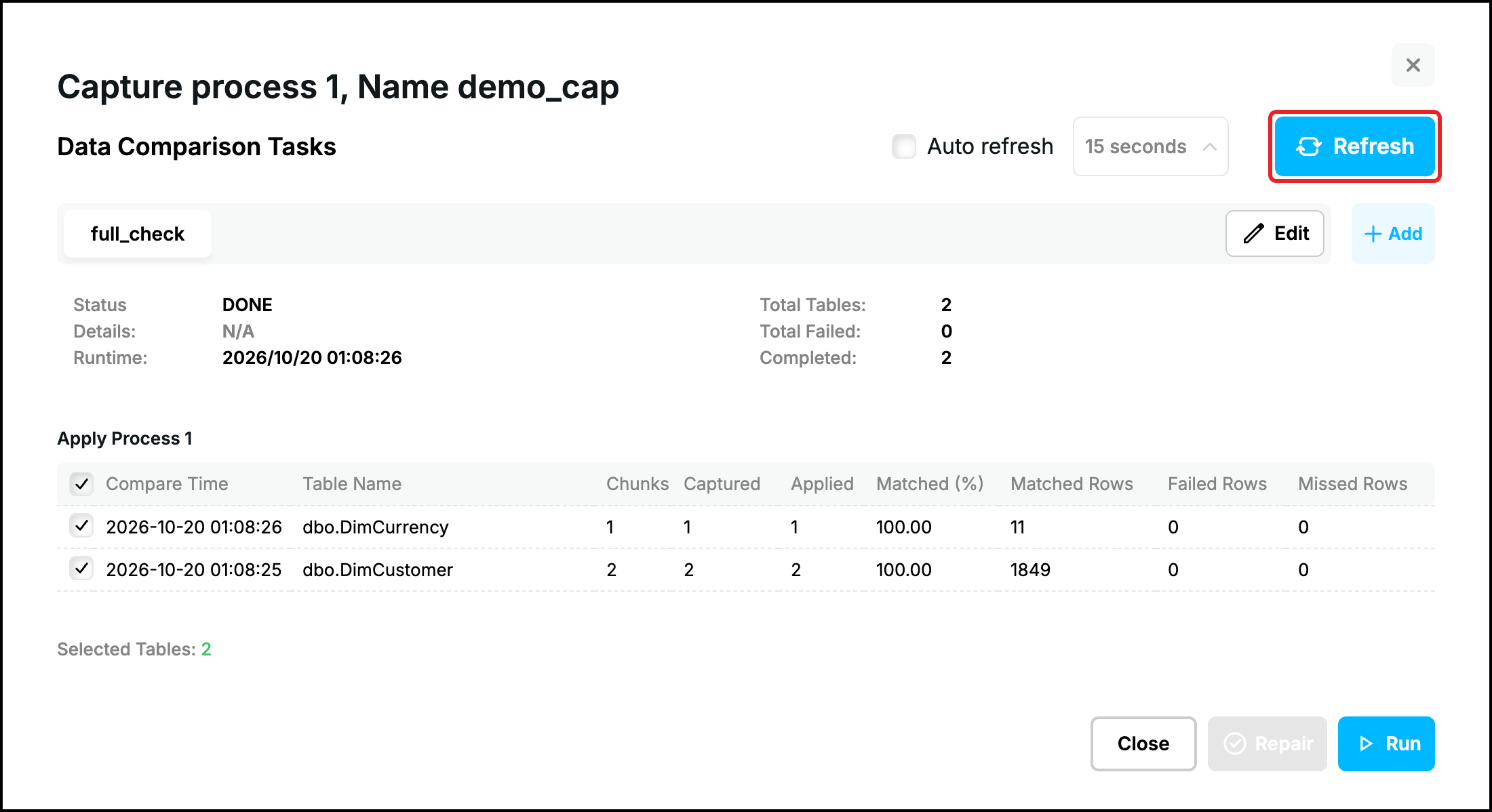
The report shows the status of the task, what it is doing at the moment (“Details”), the number of the tables and of the completed tables, and one line for each table. The “Failed Rows” column contains the number of the records that are not matched. The “Missed Rows” column shows the number of the records that are missed in the Target database:
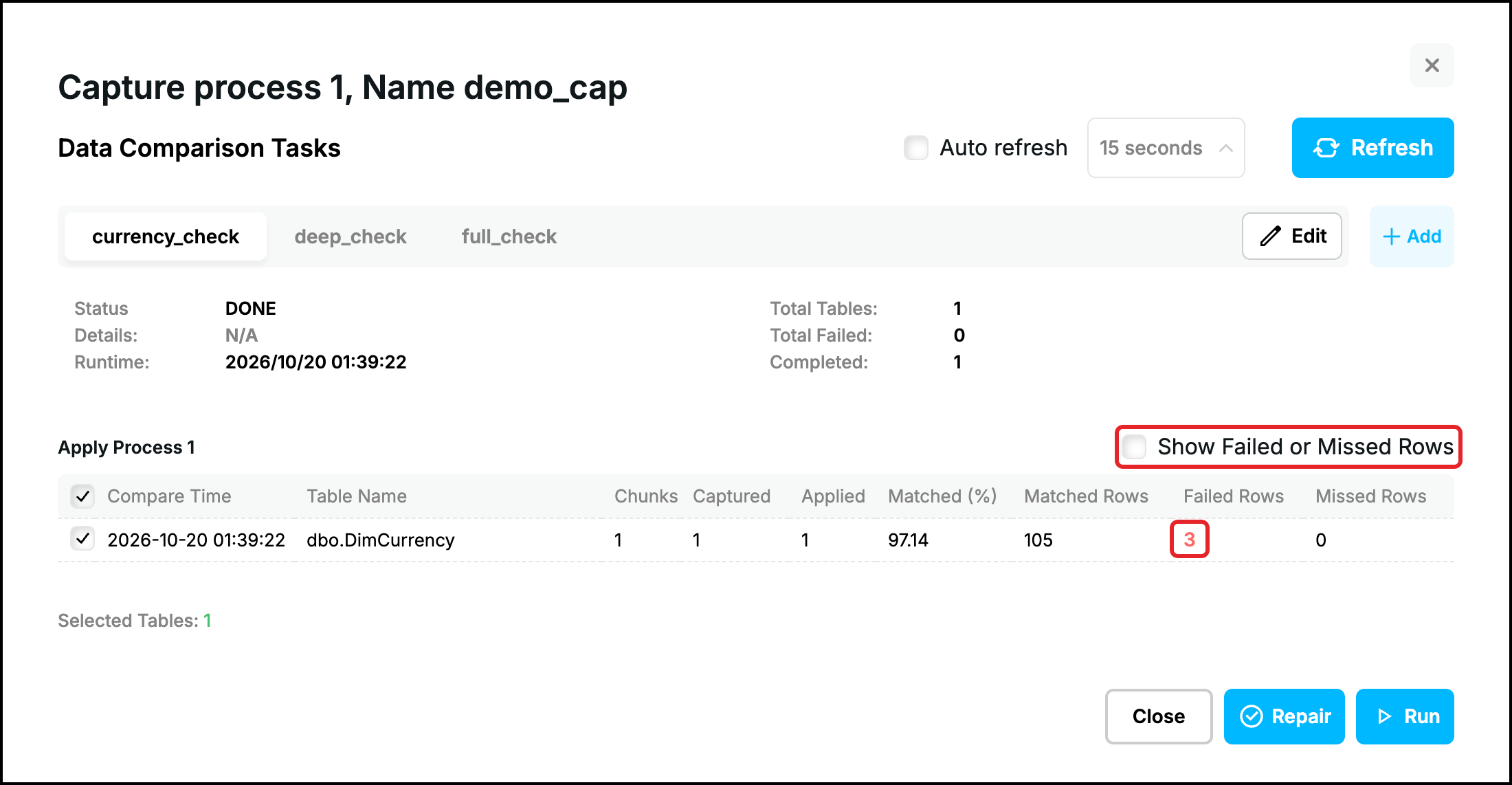
You can view the values of the key for the Failed or Missed rows by clicking the number:
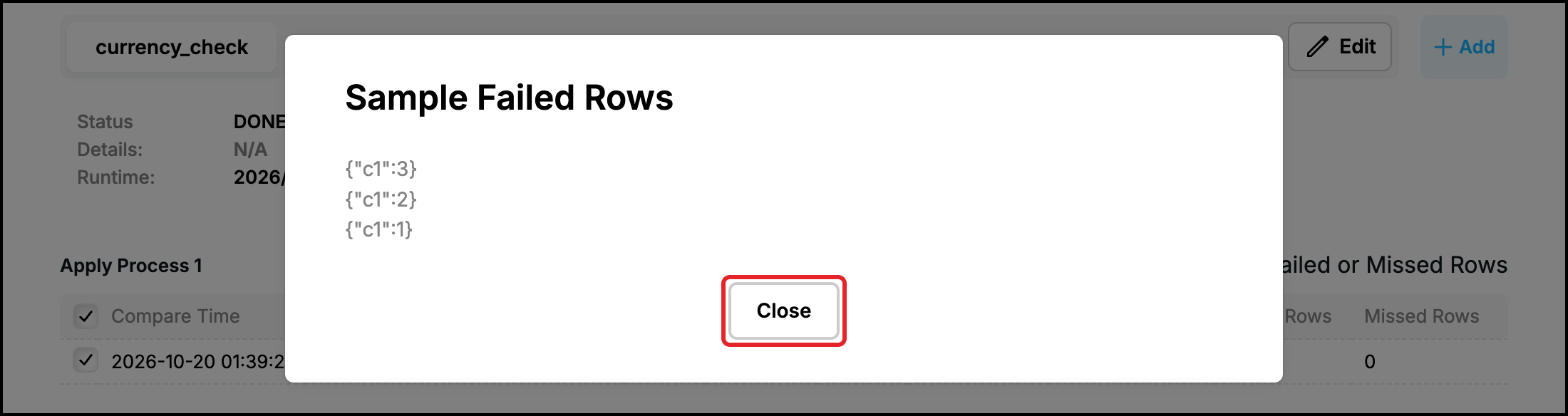
After a repair the lists are replaced by the result of the second comparison.
The parts of the report and the values of the status are explained in Compare Data and Tasks Control.
Prev page:
Remove TaskNext page:
REPSTANCE WEB USER INTERFACE- Repstance User Guide
- ABOUT REPSTANCE
- SUPPORTED DATABASE REQUIREMENTS
- GETTING STARTED WITH REPSTANCE
- INTERACTING WITH REPSTANCE SERVER
- CONFIGURE REPLICATION WITH REPSTANCE
- DATABASE CONFIGURATION COMMANDS
- PROCESS CONFIGURATION COMMANDS
- PROCESS CONTROL COMMANDS
- REPSTANCE WEB USER INTERFACE
- REPSTANCE SERVER MAINTENANCE
- MONITORING WITH AMAZON CLOUDWATCH
- MONITORING WITH AZURE MONITOR
- TROUBLESHOOTING AND FAQ
- GLOSSARY