

Redshift Apply Parameters
The following parameters are valid for the Redshift Apply Process:
Process Parameters
- process – The only possible value is apply
- id – The Apply Process id
- dbtype – Type of RDBMS, the only possible value is redshift
- capturename – The name of the Capture Process which is providing the data to be used
Database Connectivity
- server – Host name or IP address of the database server
- port – Database port
- dbname – Database name
- user – Database User name
- password – Database User password
- client_encoding – Client character set encoding. If the parameter is provided, the Apply Process runs the “SET client_encoding” command after it has connected to the Target Database. The possible values are the names of the encodings supported by the Target Database, for example UTF8 or LATIN1. By default the encoding of the connection is not changed.
S3 Connectivity
- s3.accessKeyID – S3 Access Key ID
- s3.bucketName – S3 bucket name
- s3.secretAccessKey –S3 Secret Access Key (See Manage access keys for IAM users for the details on Access Key ID and Secret Access Key)
- s3.region – AWS region
- s3.IAMRole – IAM Role with a trust policy that allows the Redshift service to access S3
Transaction Processing Parameters
- ddlcreate – Used to define the Apply Process behaviour when creating a table, if a table with the same name is found. The table is specified in schema _name.table_name format. In order to specify the list of the tables, each table must be separated by comma. The % symbol may be used in order to match any number of characters. It has the following options:
- skip– do not run DDL create command if the table already exists
- recreate – to drop the existing table and recreate it
- ddldrop – Used to define the Apply Process behaviour when dropping a table, if a table with the same name is not found. The table is specified in schema _name.table_name format. In order to specify the list of the tables, each table must be separated by comma. The % symbol may be used in order to match any number of characters. It has the following option:
- skip – do not run DDL drop command if the table doesn’t exist
- ddlprocessing – Determines if DDL must be processed based on the user statement or generated based on the dictionary changes. The possible values are:
- native – to process DDL based on the user statement
- dictionary – to generate DDL based on the dictionary changes (default value)
- map – to generate DDL based on the dictionary and the objects’ transformation rules
Note – For Homogeneous type of replication it is recommended to use "native" method of DDL processing. The "dictionary" value is commonly used in the case of Heterogeneous replication. “map” is used when the DDL statement must be reformatted following objects' transformation rules
- batchmode – This parameter is to specify transaction processing method. The possible values are:
- 0 – apply all the data changes within transactions as they were occurred in Source
- 1 – combine and process set of transactions in a single transaction
- 2 – combine set of the transactions into a single transaction and analyse data within it to produce the only one net change for each row that has been changed (default value)
- bulkthreshold – Minimum number of consecutive row changes of one table and of one operation (INSERT, UPDATE or DELETE) within a transaction, for which the Apply Process uses the bulk loading method instead of applying the changes one by one. The value 0 disables the bulk loading method. The default value is 50.
Note – Setting this value too low may cause unnecessary transactional overhead for minor updates. Setting it too high may prevent the system from ever utilizing bulk mode, resulting in slower processing times during high-volume periods.
- mergetables – The list of the tables, whose INSERT operations and Initial Load rows must be applied as MERGE (upsert) operations instead of INSERT operations. The tables are specified in schema_name.table_name format, as the names are in the Target Database after the objects mapping (case-sensitive); the tables must be separated by comma. UPDATE and DELETE operations are not affected.
Note – Each table must have a primary or unique key.
- skiploopback – Used to define the behavior of the Apply Process when inserting data, which was originally produced by Apply Processes in the Source Database as part of the “loop-back” control function, in that, this Apply Process will insert, or ignore the data. The Apply Processes to be skipped are specified by ids separated by comma. In order to specify all Processes the “all” value to be used. In order to avoid skipping any Apply Processes the “none” value to be used. The default value is “none”.
Filters and Local Transformations
- map – The set of the parameters to determine local objects’ transformation (see Objects Mapping and Possible Transforms for the details)
- filter – The set of the parameters to determine objects’ filtering (see Objects Filtering for the details)
Performance Tuning Parameters
- chunkrows – Maximum number of the row changes (SQL statements) which the Apply Process sends to the Target Database in one batch. A batch is closed as soon as either this limit or the limit of the “chunkbytes” parameter is reached. A very small value results in a large number of round trips to the Target Database. The default value is 30000.
- chunkbytes – Maximum size, in bytes, of the SQL text which the Apply Process sends to the Target Database in one batch. The values of the changed rows are a part of the text, so a batch of wide rows is closed earlier. A batch is closed as soon as either this limit or the limit of the “chunkrows” parameter is reached. The default value is 128000.
- readbytes – Approximate number of bytes of the trail data which the Apply Process reads in one cycle. The transaction that crosses the limit is still read completely. The default value is 5242880 (5 MiB).
- maxtxbytes – Size, in bytes, of a transaction above which the Apply Process reads the transaction from the trail files and applies it in parts, to keep the memory usage under control. The value 0 disables splitting of the transactions. The default value is 125829120 (120 MiB).
Other Parameters
- autostart – Determines if the Apply Process must be run automatically. Possible values are:
- 0 – do not run the Apply Process automatically (default value)
- 1 – to run the Apply Process automatically
- cleanuptrail – Determines number of days the Apply Process must keep trail files. The incremental data comparison reads the changes from these files and fails if the Apply Process has already deleted them, so use -1 or a number of days that is longer than the time between two comparisons (see Start/Stop Task and Tasks Control). Possible values are:
- -1 – Never cleanup
- 0 – Cleanup once the trail files is processed (default value)
- 1 .. 999 – Number of days the Apply Process keeps the files
- restartattempts – Number of attempts to restart the failed Apply Process automatically. The server checks the processes every 5 minutes. The value 0 disables the automatic restart. When the attempts are used up, the notification channels (see the “notification” parameter) are informed. The default value is 5.
Note – The number of attempts is restored to the full value as soon as the process makes progress after a failure.
- notification – The ids of the notification channels, separated by comma (see Monitoring Replication for the details on the channels), which are informed by e-mail when the process has failed and can not be restarted automatically any more (see the “restartattempts” parameter). By default nobody is notified.
- debuglevel – The level of debugging. Possible values are 0-15
- preview – Determines if the configuration of the “prepare” or “alter” command must be saved. The possible values are:
- 0 – save the configuration (default value)
- 1 – do not apply the configuration to the Apply Process but provide the list of the tables to be applied along with the transformation rules. The trail files of the Capture Process must exist
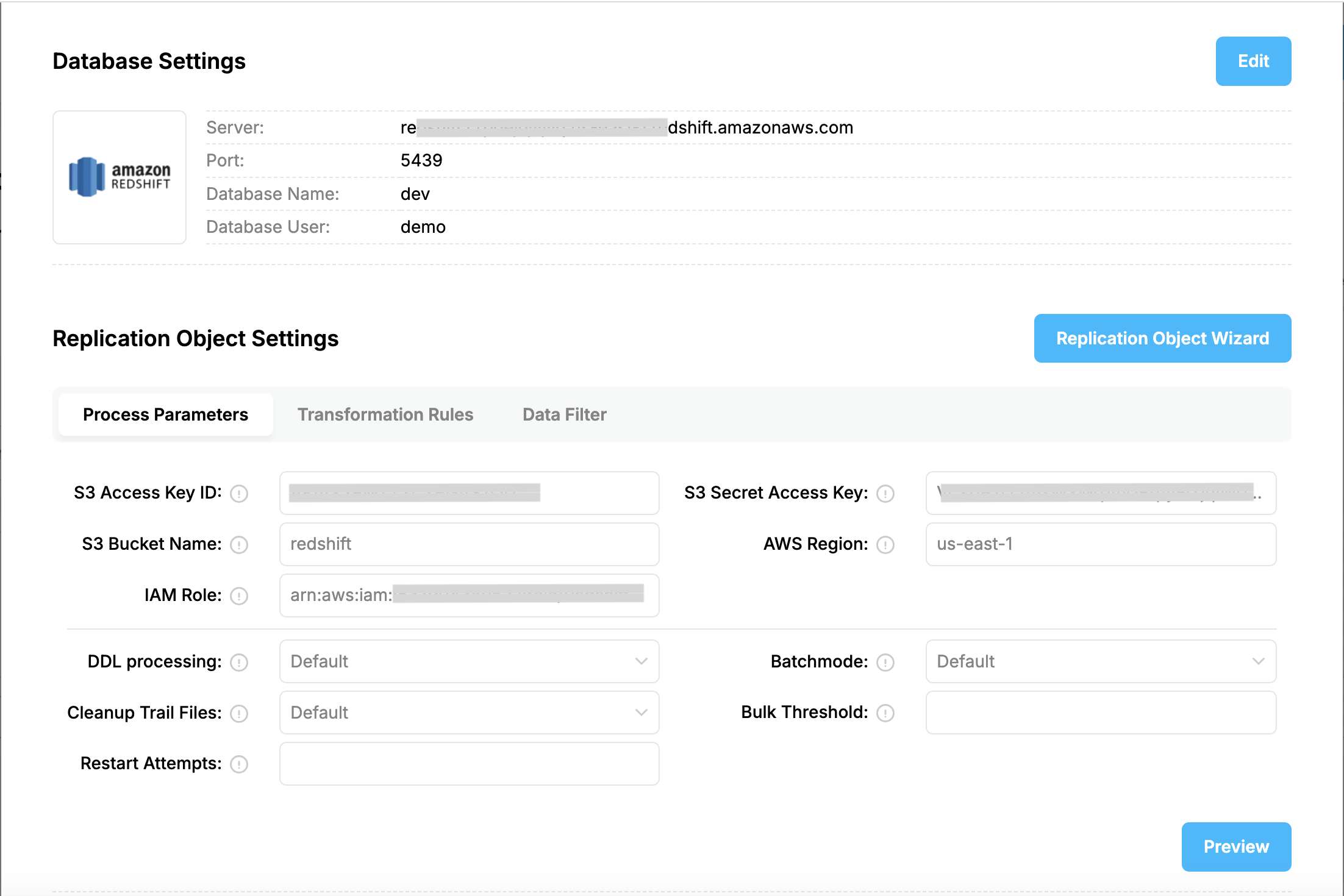
Web UI
Prev page:
Snowflake Apply ParametersNext page:
AWS S3 Apply Parameters- Repstance User Guide
- ABOUT REPSTANCE
- SUPPORTED DATABASE REQUIREMENTS
- GETTING STARTED WITH REPSTANCE
- INTERACTING WITH REPSTANCE SERVER
- CONFIGURE REPLICATION WITH REPSTANCE
- DATABASE CONFIGURATION COMMANDS
- PROCESS CONTROL COMMANDS
- DATA COMPARISON
- REPSTANCE WEB USER INTERFACE
- REPSTANCE SERVER MAINTENANCE
- MONITORING WITH AMAZON CLOUDWATCH
- MONITORING WITH AZURE MONITOR
- TROUBLESHOOTING AND FAQ
- GLOSSARY