

Redshift as Target
Note – Redshift is supported as a Target by Repstance Advanced Edition only (see Supported Database Requirements).
These parameters are used by prepare, validate and remove with database=target dbtype=redshift (see Prepare Target Database, Validate Database and Remove Repstance Objects from Database). The login that is given in user needs the privileges that are described in Database Privileges.
Parameters
| Parameter | Description |
|---|---|
| database | target. Required. |
| dbtype | redshift. Required. |
| generatesql | 1 makes prepare return the SQL script and change nothing. The default is 0: prepare creates the objects. validate does not use the parameter, and remove removes the objects whatever its value. |
| server | The host name of the cluster. Required. |
| port | The TCP port of the cluster, usually 5439. Required. |
| user | The login that Repstance connects with. Required. |
| password | The password of the login. Required. |
| dbname | The database to connect to: the schema repi is created in it. Required, except with generatesql=1. |
validate checks the objects of the database only. It does not test the parameters of the Apply Process that Redshift needs to read the files in the S3 bucket (see Redshift Apply Parameters).
Examples
Return the script instead of running it. No connection is made:
repcli prepare database=target dbtype=redshift server=rs-tgt.example.com port=5439 dbname=testDB user=repuser password=Passw0rd123 generatesql=1
[Completed]:
---- SQL ----
create schema if not exists repi;
create table if not exists repi.apply_ckpt(
        apply_id int primary key,
        file_sequence int not null,
        md_sequence int not null,
        position bigint not null,
        first_lsn char(22) not null,
        ckpt_lsn char(22) not null,
        ckpt_lsntime timestamp,
   ldckpt bigint not null default 0,
        cntd int  not null default 0,
...
Web UI
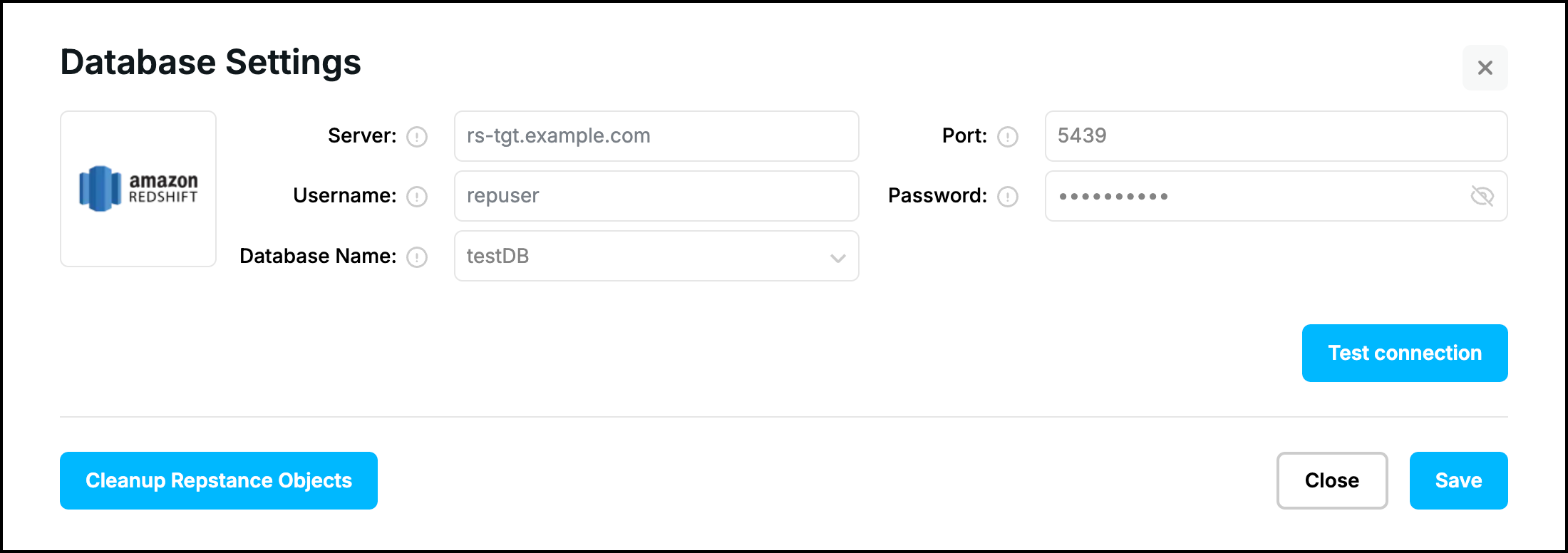
The form “Database Settings” of an Apply Process for Redshift has the fields “Server”, “Port”, “Username”, “Password” and “Database Name” (the list shows the databases of the cluster). The buttons that prepare the database are shown in Prepare Target Database:
Prev page:
Snowflake as TargetNext page:
AWS S3 as Target- Repstance User Guide
- ABOUT REPSTANCE
- SUPPORTED DATABASE REQUIREMENTS
- GETTING STARTED WITH REPSTANCE
- INTERACTING WITH REPSTANCE SERVER
- CONFIGURE REPLICATION WITH REPSTANCE
- PROCESS CONFIGURATION COMMANDS
- PROCESS CONTROL COMMANDS
- DATA COMPARISON
- REPSTANCE WEB USER INTERFACE
- REPSTANCE SERVER MAINTENANCE
- MONITORING WITH AMAZON CLOUDWATCH
- MONITORING WITH AZURE MONITOR
- TROUBLESHOOTING AND FAQ
- GLOSSARY